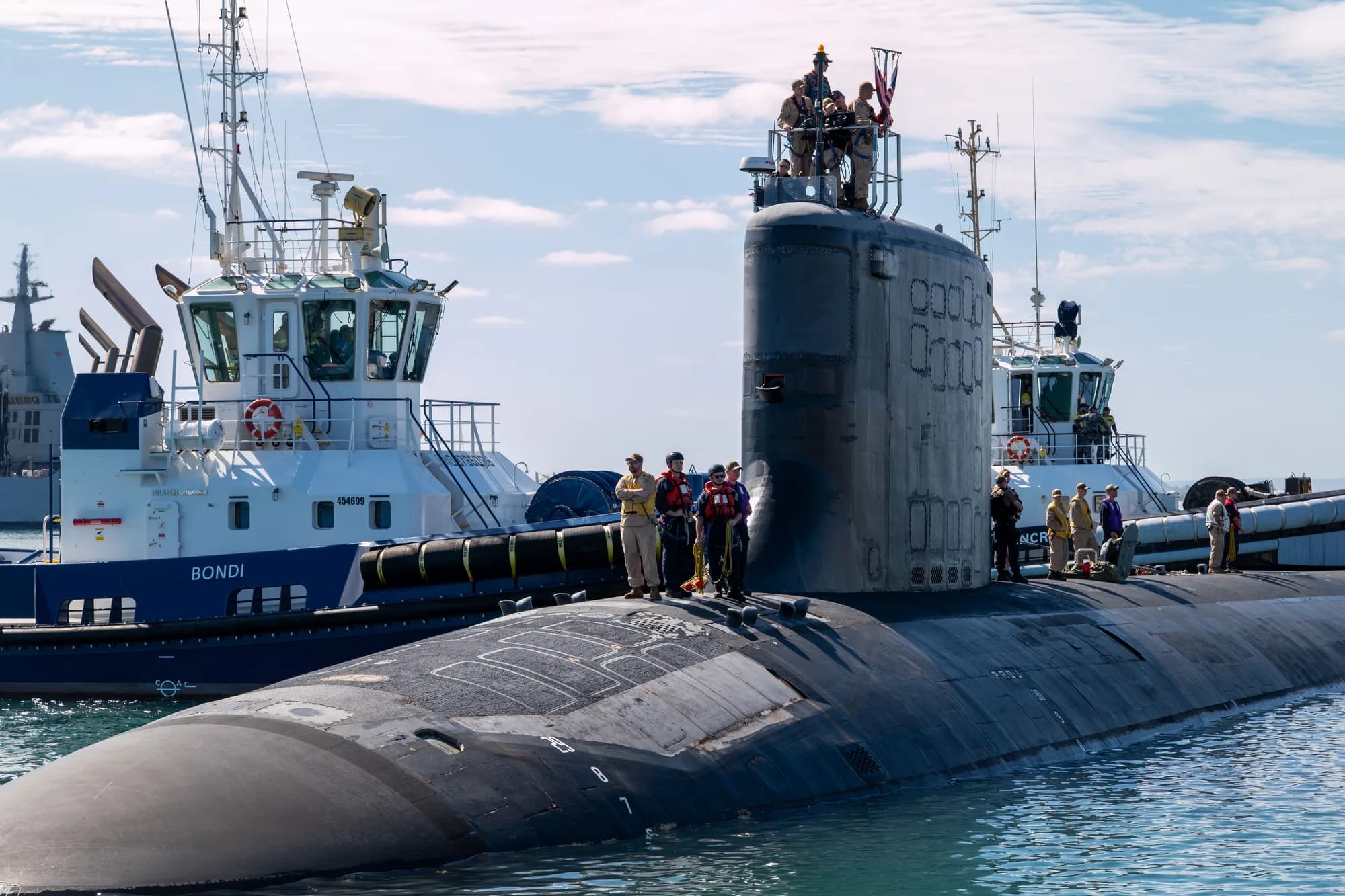
Cockburn Sound, Western Australia
Western Australia is building a container port beside the submarine base America is spending billions to use.
The project is called Westport. It moves Western Australia’s container terminal to Kwinana and rebuilds it as an automated port, about 3.7 miles across the water from HMAS Stirling, the base where United States nuclear submarines will rotate under AUKUS.
Watch the campaign videoWatch: what is at stake in Cockburn Sound
Just over a minute on why a state infrastructure decision made before AUKUS existed is now a question about American submarines.
Made for social
The same case cut vertical and captioned, so it reads with the sound off. Sixty seconds, and built to be shared.
What this campaign is asking Congress to do
We call on the United States to conduct a security risk assessment examining the proposed Westport container port and its potential interactions with AUKUS operations in Cockburn Sound, Western Australia. The assessment should identify and evaluate risks to submarine movements, naval operations, commercial freight traffic in Western Australia and security in Cockburn Sound to inform decisions about the project.
This is not about whether you support AUKUS. Moving all of Western Australia's container freight into a single automated port across the water from HMAS Stirling puts the state's supply chain and the submarine program in the same few miles of water, and no risk assessment of that has been published.
Three things a decision made in Perth does to American assets
Each figure is sourced and explained in full on the Evidence page.
3.7 miles
The commercial docks would sit under four miles from the submarine base
Westport moves Western Australia's container terminal to Kwinana, on the eastern shore of Cockburn Sound, and builds it as an automated terminal. HMAS Stirling, where US Virginia-class submarines will rotate, is directly across the water. Vessels waiting at anchor can sit closer still.
One channel
The container ships would cross the submarines' own transit route
Cockburn Sound has one navigable entrance, and every submarine movement and every commercial movement passes through it. Inside the sound it gets worse: the route submarines take between HMAS Stirling and their maintenance facility at Henderson runs straight across the shipping channel serving the new terminal. Traffic through that water is projected to more than double.
15 ships
Almost none of that shipping is Australian
Australia has fifteen Australian-flagged commercial vessels over 2,000 tons. Virtually every ship transiting the sound beside the submarines is foreign-flagged, with the visibility and vetting that implies.
Figures from the August 2025 assessment by Air Vice-Marshal John Blackburn AO (Retd) and Commodore Vince Di Pietro AM CSC RAN (Retd). Every source is listed on the Evidence page.
The ships would not just share the door. They would cross the corridor.
The submarine base is on Garden Island, on the western shore. The maintenance facility planned for those submarines is at Henderson, on the mainland to the north. Boats moving between the two cross Cockburn Sound, from one side to the other, as a matter of routine.
The shipping channel serving the proposed terminal runs down that same water. The two routes intersect. A wider entrance does not fix it and a second channel does not fix it, because the conflict is created by where the terminal is put, not by how the water is approached.
Understand the threat
What Westport is, where it sits relative to the submarine base, and why the combination puts American assets and American spending at risk.
Take action
The ask, stated plainly, with everything you need to raise it in a congressional office or a newsroom.
Share this page
Help this reach more people who can act on it.